

With the livestock markets closed Monday for Labor Day, it seemed like a good time to step back and take a look at the daily charts for Live Cattle, Feeder Cattle and Lean Hogs.
These three markets have taken very different paths recently. Live Cattle and Feeder Cattle are both well below their major highs, while Lean Hogs has been much quieter and is attempting to stabilize.
Let’s take a quick look at each one.
October Live Cattle
October Live Cattle has pulled back substantially from the highs made back in the Spring, and more recently in June.
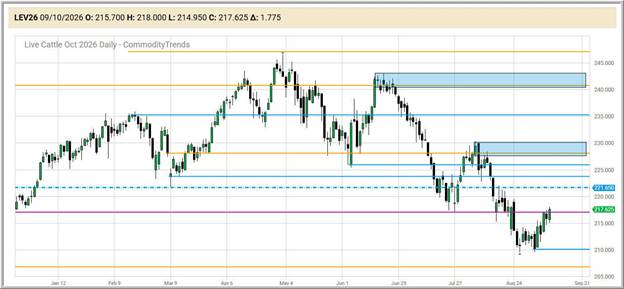
After such a strong run, the market has spent the past several months moving lower, producing a series of lower highs and lower lows on the daily chart.
For now, I’m looking to see whether this decline continues or whether the current retracement ultimately proves to be a correction within the longer-term trend.
I’ve marked several important support and resistance areas on the chart. Rather than trying to predict what will happen next, I’ll simply watch how price reacts as it approaches those levels. (It’s currently trading just above the purple monthly chart resistance level.)
There is no reason to force a trade. Sometimes the best thing we can do is wait.
October Feeder Cattle
Feeder Cattle has also experienced a sizable correction after reaching extremely high levels in May and June.
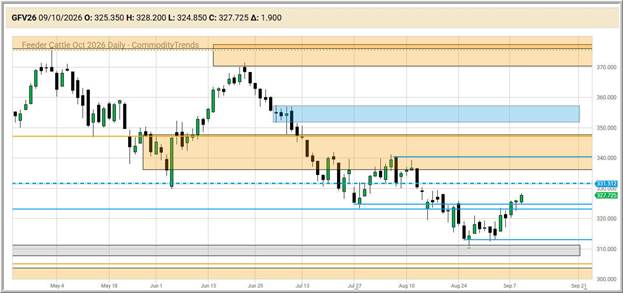
Recently, the market has attempted to bounce from its lows and is just below the blue dashed-dotted line, which is the daily chart 50% level. That certainly makes the chart more interesting, but one bounce by itself doesn’t necessarily mean the decline is over.
I’ll be watching the nearby support area closely, along with the resistance levels above. If the market continues to strengthen, we may eventually see a more meaningful bottoming pattern develop.
If sellers return, however, the recent rally may simply turn out to be another bounce within the broader decline.
Either way, I want the chart to provide confirmation before becoming interested in a position.
October Lean Hogs
Lean Hogs may be the most interesting of the three simply because the market has developed a 1-2-3 bottom formation.
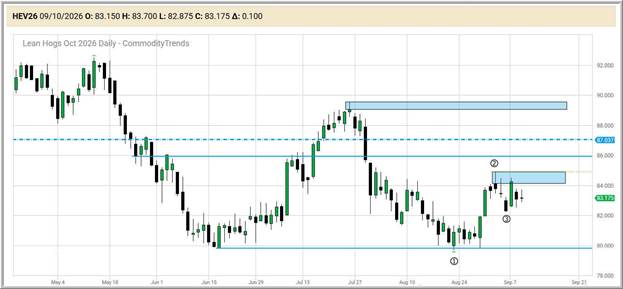
At this point patience is the key. So, keep watching closely for an opportunity to apply the 1-2-3 strategy if it triggers.
That may not sound particularly exciting, but quiet markets can sometimes be worth watching. Sideways movement can eventually develop into a base and produce a larger move once price finally breaks out.
For now, I’m watching the support underneath the market and the resistance above it. If the right chart pattern begins to develop, Hogs could become much more interesting.
At this point, though, I’m still watching from the sidelines.
What I’m Watching
These three livestock markets are currently telling three different stories.
Despite the differences, my approach remains the same.
I’ve marked the important support and resistance areas, and I’ll watch how price behaves around those levels, and wait to see whether one of my preferred setups develops. If one does, I’ll act accordingly.
There’s no need to predict every move. The market will eventually tell us what it wants to do. Our job is to be patient enough to listen.
The Next Step
If you're new to CommodityTrends, our memberships take these ideas further. We show you how we read the charts in real time, analyze the markets each day, and identify potential trading opportunities as they begin to develop.
To learn more about our memberships, visit: https://www.commoditytrends.com/register
— Jim Prince, CommodityTrends.com
Educational content only. Futures and options trading involves substantial risk of loss and is not suitable for every investor. Nothing here is a recommendation to buy or sell any contract. Past performance is not indicative of future results.