
Patience as a Competitive Edge: The Quiet Skill That Beats Most Futures Traders
Why sitting on your hands is one of the most underrated weapons a trader can own.
Let me ask you something. When you picture a great trader, what do you see?
I'll bet it's somebody fast. Quick on the keys, eyes on six screens, jumping in and out, riding the action all day long. That's the picture the movies sold us. Lots of noise. Lots of motion. Lots of clicking.
Here's the funny thing. After 36 years in this business, the best traders I know look almost nothing like that. They're quiet. They're calm. And most of the time? They're doing absolutely nothing. They're waiting. And that waiting — that plain, boring, unglamorous patience — is one of the biggest edges in the whole game.
Why Doing Nothing Is Doing Something
We've got it backwards in our heads. We think a trader gets paid to trade. So if we're not in a position, we feel like we're slacking. Like we're leaving money on the table. Like a fisherman who hasn't cast his line.
But trading isn't fishing. It's hunting. And a good hunter spends most of his time still.
When you're not in a trade, you're not doing nothing. You're doing the most important thing there is — you're protecting your money and waiting for the right pitch. Every dollar you don't lose on a so-so setup is a dollar that's ready for a great one. Cash sitting in your account isn't lazy. It's loaded.
Why does this matter so much? Because the market doesn't hand out good setups on a schedule. It doesn't care that you sat down at your desk this morning hoping to trade. Some weeks the charts line up beautifully. Some weeks they're a mess and the smartest thing you can do is fold your arms and let them stay a mess. The patient trader knows the difference. The impatient one trades anyway — and pays for it.
Patience isn't the absence of a plan. Patience is the plan, doing its job.
The Itch That Costs You Money
Now let's talk about the thing that wrecks more good intentions than anything else. The itch.
You've felt it. You sit down, you scan your charts, and there's nothing there. Nothing clean. Nothing worth your money. And instead of turning off your monitor and going to mow the lawn, you keep looking. And looking. And pretty soon that itch starts whispering. "There's gotta be something. Look harder. What about this one? That could work, right?"
That's not analysis. That's boredom wearing a necktie.
When you go looking for a trade because you want one, you'll always find one. The mind is good like that. It'll talk you into a so-so chart the same way a hungry man talks himself into a gas-station hot dog. Not because it's good. Because it's there.
And here's the trap. Those itch trades — the ones you took just to be doing something — are almost never your winners. They're the ones you put on at ten in the morning out of restlessness and spend the rest of the day babysitting. The setup was never really there. You manufactured it. The market didn't offer you a trade; your boredom did.
The cure isn't more discipline in the moment. The cure is knowing, before you ever sit down, that no trade is a perfectly good outcome for the day. Flat is a position. Cash is a position. And on a lot of days, it's the best one available.
Patience Is Where Your Edge Actually Lives
Here's something that took me years to really feel in my bones. Your edge — whatever it is, whatever system you trade — only works when the conditions are right for it.
Think about a great baseball hitter. He doesn't swing at everything. The good ones are famous for not swinging. They let pitch after pitch go by, ball after ball, waiting for the one in their wheelhouse. They know their average on a pitch down the middle is fantastic, and their average on a pitch at their ankles is lousy. So they wait. They make the pitcher come to them.
You've got a wheelhouse too. Your methodology — mine is CTTP — is built to spot certain conditions on the charts. When those conditions show up, you've got an edge. When they don't, you've got a coin flip dressed up as a trade. And no amount of wanting changes which one you're looking at.
So patience isn't some virtue I'm preaching at you to feel good. It's mechanical. It's math. Your edge has a wheelhouse, and your job is to wait for the pitch to land in it. Swing at everything and you turn a good hitter into a .180 hitter in a hurry. Wait for your pitch, and you let your edge be an edge.
That's the whole reason I trade off of the higher timeframe charts instead of staring at one-minute bars all day. The higher timeframe charts slow the game down. They force you to wait. They take the itch out of your hands by simply not giving you a new decision every sixty seconds. Slower isn't a limitation. For a patient trader, slower is the point.
How to Build the Patience Muscle
So how do you get there? Because I know "just be patient" is about as useful as a coach yelling "just score more points." Let me give you a few things that actually helped me.
First, define what you're waiting for before the day starts. When you know exactly what a good setup looks like to you, the in-between stuff stops being tempting. It's easy to pass on a mediocre chart when you've got a crystal-clear picture of a great one in your head. You're not saying no to trading. You're saying not yet.
Second, make peace with the flat day. Write it on a sticky note if you have to: a day with no trade is a day I did my job. The trader who can sit through a quiet Tuesday without forcing something is the trader who's got money and a clear head when Thursday lights up.
Third, give yourself something else to do. Patience is a lot easier when your whole day doesn't hang on a trade. Go for a walk. Study old charts. Read. The trader chained to the screen, knuckles white, needing something to happen — that's the trader who breaks first. Slack in the line isn't weakness. It's how you keep from setting the hook on the wrong fish.
And fourth, keep score on the trades you didn't take. Most folks only track their trades. Start noticing the junk setups you passed on that went nowhere. It's awful satisfying. Pretty soon, passing feels like winning — because it is.
Final Thoughts
Here's the part nobody tells you when you start out. This business doesn't reward the busiest trader. It rewards the most prepared one — the one who's still got chips and a clear mind when the great setup finally walks through the door.
Patience feels like nothing while you're doing it. It feels like sitting out. It feels like you're missing the party. But the party usually ends with a hangover, and the patient trader's the one who skipped it and showed up fresh the next morning.
The market will always give you another pitch. Always. Your only job is to be standing there, calm and ready, when it lands in your wheelhouse.
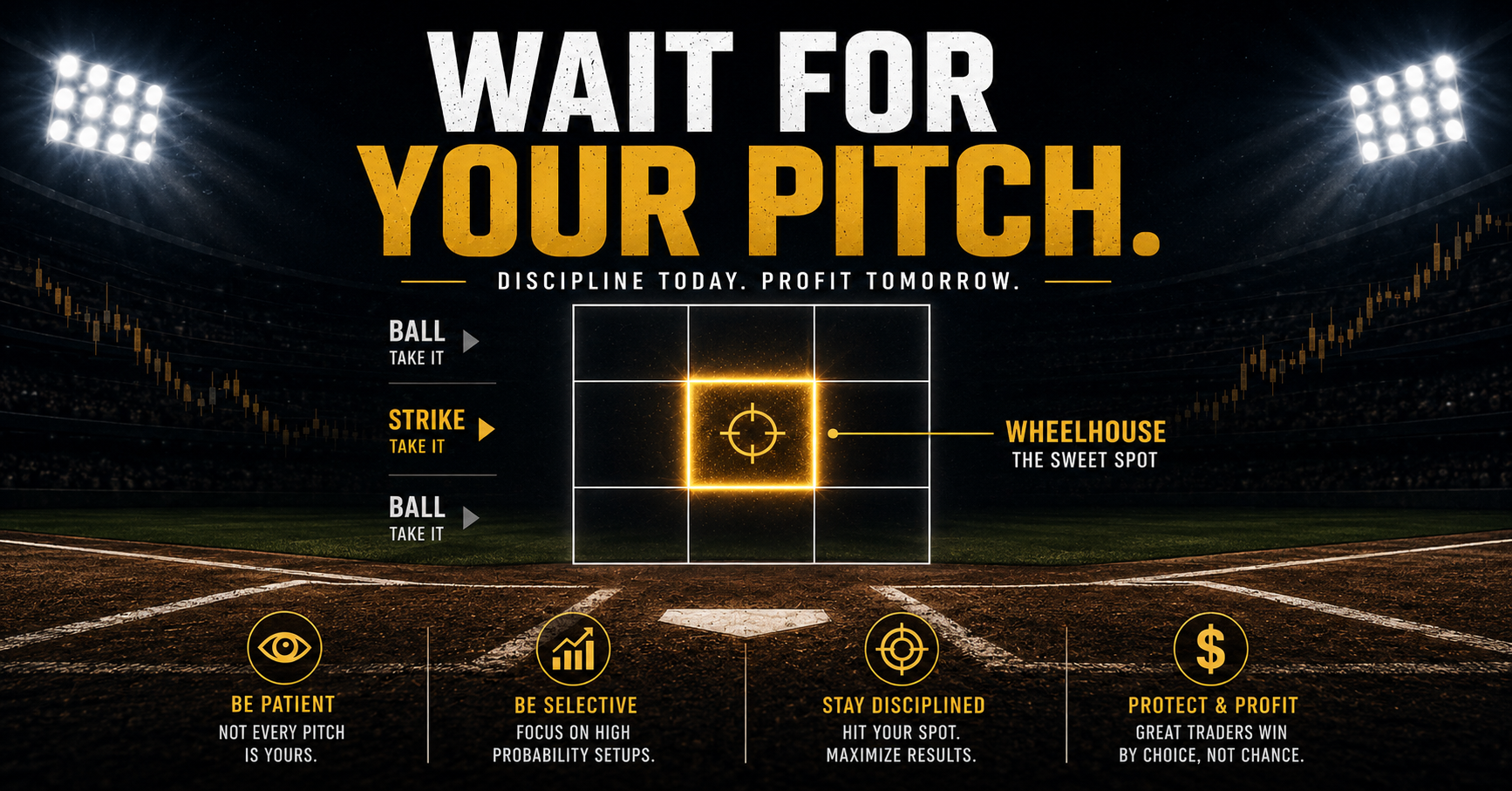
So the next time that itch starts whispering, do the hardest, most professional thing there is.
Sit on your hands. Wait for your pitch. That's the edge.
— Jim Prince,
[CommodityTrends.com](http://www.commoditytrends.com)
Educational content only. Futures and options trading involves substantial risk of loss and is not suitable for every investor. Nothing here is a recommendation to buy or sell any contract. Past performance is not indicative of future results.