
Turn on the TV any morning and you'll get an earful. Tariffs. Weather. Earnings. Some expert in a nice suit telling you exactly where crude oil is headed and why.
Sounds helpful, right? Here's the problem. There’s an extremely high probability that same channel had a different expert on yesterday saying the opposite thing. And both of them sounded smart. Both may have had charts and numbers and very serious voices.
After 36 years of being involved with the markets, I can tell you what I do with all that noise. I turn it off because the news is a terrible place to get your trading signals. Let me share the reasons why.
The News Is Already in the Price
Here's the first thing every futures trader needs to understand. By the time a headline reaches you, the market has already voted on it.
Think about who's on the other side of your trade. Grain companies with people standing in the fields. Energy firms with analysts who do nothing but study pipeline information all day. Then there are the funds with computers reading the news faster than you can blink. When a story breaks, these folks have already acted on it before your coffee gets cold.
So, when you go long soybeans because of a bullish headline, you're not early. You're generally late. In other words, you're the last guest at a party where the food's already gone.
Why does this matter? Because trading is about what happens “next,” not what has happened already. The headline tells you why price moved this morning. It tells you nothing about where price goes tomorrow. And tomorrow is the only place money can be made.
The news explains the past. The chart shows the past, but also prices the future.
Headlines Tell You What Happened. Charts Tell You What Traders Did About It.
Now here's the part that took me years to appreciate. Sometimes the most valuable information isn't the news itself. It's how the market responds to the news.
Have you ever seen a market get hit with terrible news and barely flinch? Or better yet, close higher on the day? That's the chart talking. It's telling you the selling is likely exhausted — that everybody who wanted out is already out. No headline will ever tell you that. Only the chart can.
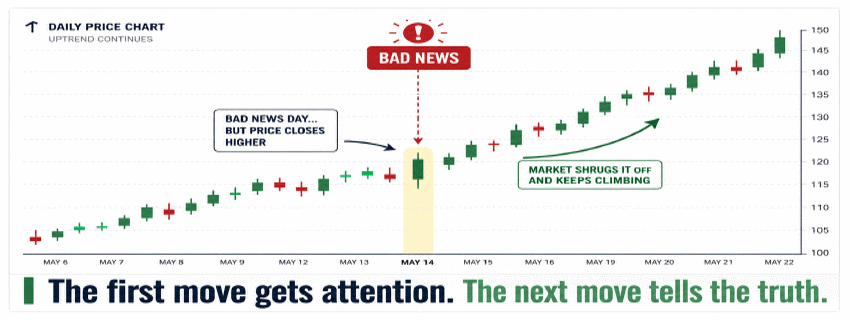
And the reverse is just as true. A market that gets wonderful news and can't rally? Hmm, that market is likely in big trouble. The chart just told you something the headline never could.
I wrote a line in one of my newsletters this spring that I'll repeat here because it fits: the first move gets attention, but the next move tells the truth. The knee-jerk reaction to a headline is noise. The follow-through — or the lack of it — is signal. You find that signal in exactly one place. On the chart.
That's why my whole approach, the CTTP methodology, starts and ends with price. Not opinions. Not forecasts. Price. Because price is the one thing that never lies to you about what traders are doing with real money. In other words, price pays!
The Trouble with Tips, Hunches, and Your Neighbor's Cousin's Uncle
Let's talk about the other flavor of news trading. The tip.
You know the one. Your neighbor's cousin's uncle works near a refinery and says gasoline is about to take off. A fellow in an online forum swears cocoa is the trade of the year. Your brother-in-law heard something at a barbecue.
Can I be blunt? In my opinion a tip is just a headline with worse sourcing.
Here's the real problem with trading on tips and hunches, and it's not that they're always wrong. Sometimes they're right! But again, the stopped clock is right twice a day. Anyway, the problem is you can't manage a trade you can't see. If you bought gasoline on your neighbor's cousin's uncle's say-so, tell me: where's your stop? Where do you take profits? How do you know if the idea is failing? You don't. You're trading from the hip, and traders who trade from the hip eventually shoot themselves in the foot.
A trade built on a chart comes with a map. You can see the structure. You can see where you're wrong. You can plan the whole trade before you risk a dime. A trade built on a tip comes with nothing but hope. And hope is not a strategy.
What "Trading the Chart" Actually Looks Like
So, what's the alternative? Well, it’s simple to describe. Trading the chart means the chart must earn your money. Not a story. Not a feeling. Not a talking head. Before I ever risk a dollar, the price action itself must set up in a way my plan recognizes — and my plan tells me the entry, the stop, and how I'll manage the trade before I ever click the mouse. If the chart doesn't offer that, I don't trade. Period. It doesn't matter how exciting the story is.
Think of it like a football coach on game day. He's heard all week what the newspapers say about the other team. Is it interesting? Sure. But when gametime comes, he doesn't coach from the sports page. He coaches from his game plan, and he adjusts based on what's happening on the field. The field is the chart. The sports page is the news. Good coaches know the difference.
And here's some good news of my own: this approach is easier, not harder. When you trade the chart, you can skip the exhausting business of following every headline, every rumor, every expert's opinion. You don't need to know more than the news traders. You just need to watch what they do — and it's all right there on a daily chart, one bar at a time. The news can't surprise a trader who wasn't leaning on it in the first place.
Final Thoughts
I'm not telling you to live in a cave. The news gives you reasons. The chart, however, gives you prices. You can't deposit reasons.
So, the next time a headline has your heart pounding and your finger hovering over the buy button, take a breath and ask one question: what does the chart say? If the chart agrees, you don’t need the headline. And if the chart disagrees. . .
Trust the chart. It's the only reporter that never spins the story.
— Jim Prince, CommodityTrends.com
Educational content only. Futures and options trading involves substantial risk of loss and is not suitable for every investor. Nothing here is a recommendation to buy or sell any contract. Past performance is not indicative of future results.